> For the complete documentation index, see [llms.txt](https://docs.usepylon.com/pylon-docs/llms.txt). Markdown versions of documentation pages are available by appending `.md` to page URLs; this page is available as [Markdown](https://docs.usepylon.com/pylon-docs/integrations/crm/salesforce.md).
# Salesforce
## Setup
Click into the App Directory from your Pylon dashboard and then click on the Salesforce integration to view setup instructions.
## Usage
#### Account Matching
Accounts are mapped using domain and name matching between Salesforce and Pylon by default. The integration can also be configured to match on Pylon account custom fields, or on the Pylon **Account ID** stored in a Salesforce field (for example, a `Pylon_Account_ID__c` field). Field rules match exactly, so accounts link to the intended record. When a custom matching rule compares the Pylon account's domain to a Salesforce field, Pylon reads that field as a list: comma-, semicolon-, and newline-separated domains are each checked, and exact domain matches take priority over partial matches. For more details, see [How does Salesforce default account matching work?](https://support.usepylon.com/articles/5375363376-how-salesforce-default-account-matching-works)
### Activity Sync
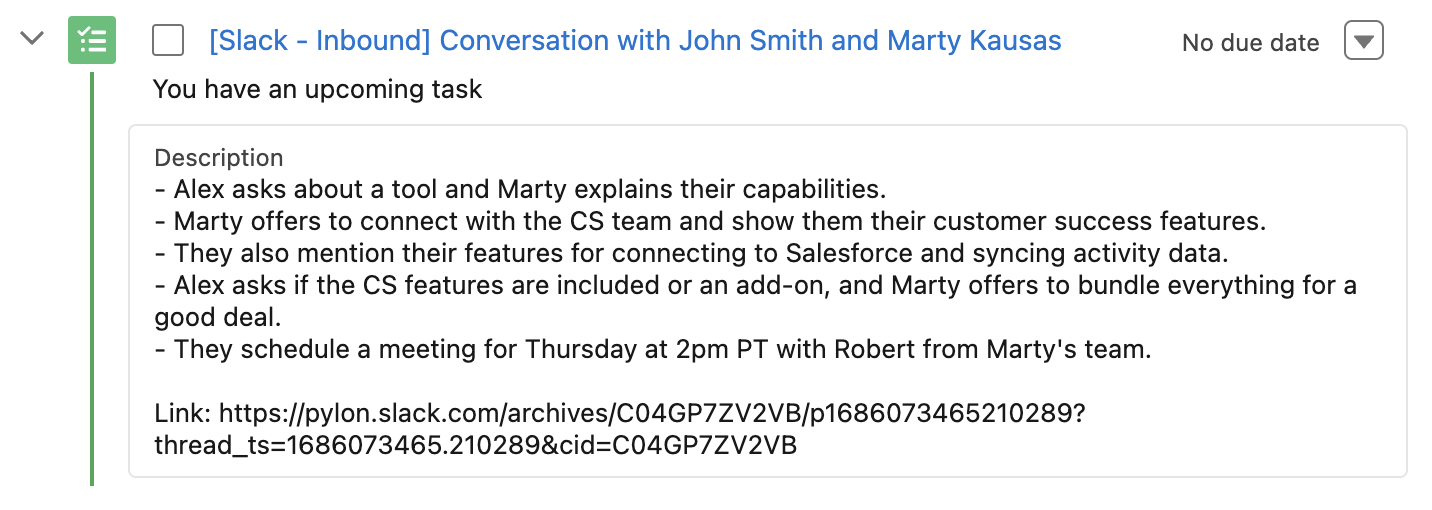
Pylon scans customer conversations daily, summarizes eligible conversations with AI, and syncs each summary to the matching Salesforce account.
Under **Integrations > Salesforce > Settings > Syncs**, you can filter **Activity sync** by channel, issue type, or source. Use **Add filter** to set conditions, combine them with AND or OR, then save. With no filters, all issue activity is eligible to sync. Changing your filters does not update or remove activities already synced to Salesforce, or backfill historical activity.
### Field Sync
Either sync fields from Pylon or to Pylon from Salesforce. Fields synced into Pylon are available to use in all Pylon feature, like as filters in views, triggers, macros, etc.
### Contact Sync
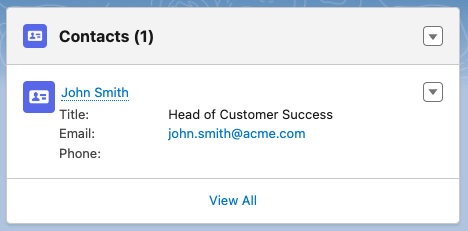
When contact sync is enabled and someone new joins a prospect or customer channel, Pylon adds that contact to Salesforce and links it to the relevant `Account`.
To enable this, open Salesforce in the App Directory, go to **Data mapping > Contacts > Sync settings**, and turn on **Sync Pylon contacts to Salesforce**, then click **Save** in the bar at the bottom of the page.
### Channel Creation from Salesforce
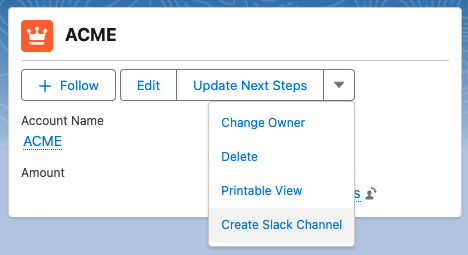
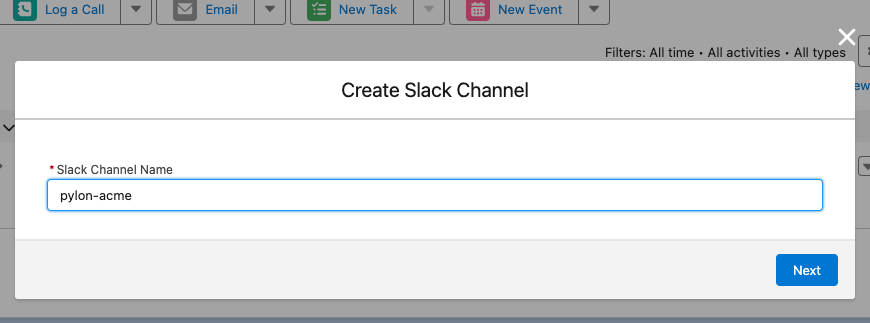
You can greatly simplify Slack channel creation using our Salesforce widget. Click `Create Slack Channel` from Salesforce, name the channel, and the following will automatically happen:
1. Channel will be created and named
2. All `Opportunity` `Contact Roles` will be invited to join the channel
3. Pylon will be enabled within the channel
4. `Invitees` from the customer side will be sent a `Welcome Message` once they join the channel if you have one configured in Pylon.
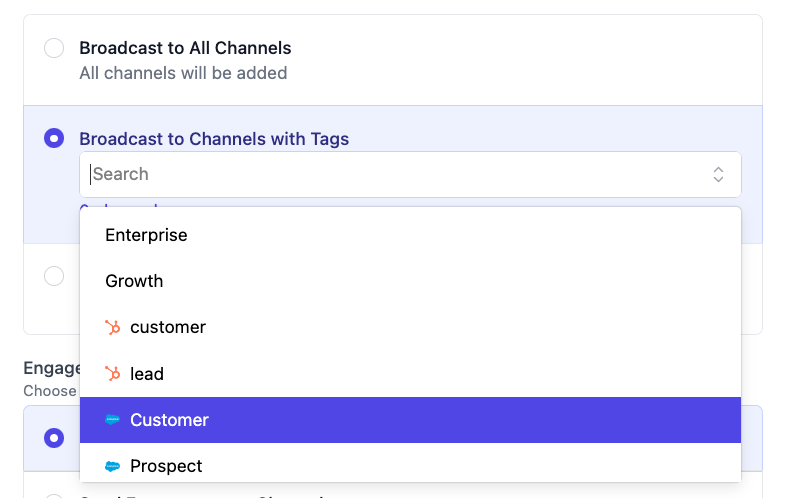
### Broadcast Filtering
You may want to send a Broadcast to a set of customers based on data stored in Salesforce.
### Issues
View and filter `Issues` by any attributes from Salesforce.
### Account Details on Issue
See account level details while working on an individual issue in the Issue sidebar.
---
# Agent Instructions
This documentation is published with GitBook. GitBook is the documentation platform designed so that both humans and AI agents can read, navigate, and reason over technical content effectively. Learn more at gitbook.com.
## Querying This Documentation
If you need additional information that is not directly available in this page, you can query the documentation by asking a question.
Perform an HTTP GET request on the following URL with the `ask` and `goal` query parameters:
```
GET https://docs.usepylon.com/pylon-docs/integrations/crm/salesforce.md?ask=&goal=
```
`ask` is the immediate question: it should be specific, self-contained, and written in natural language.
`goal` is what the user is ultimately trying to achieve, the reason they need the answer. Sharing it helps GitBook give you a better, more relevant answer. A goal is most helpful when it describes the outcome the user wants rather than restating the question. For example, with `ask=how do I create an API token`, a goal like `automate deployments from our CI pipeline` lets GitBook tailor the answer to that use case.
The response will contain a direct answer to the question and relevant excerpts and sources from the documentation.
Use this mechanism when the answer is not explicitly present in the current page, you need clarification or additional context, or you want to retrieve related documentation sections.