> For the complete documentation index, see [llms.txt](https://docs.usepylon.com/pylon-docs/llms.txt). Markdown versions of documentation pages are available by appending `.md` to page URLs; this page is available as [Markdown](https://docs.usepylon.com/pylon-docs/integrations/chat/slack/support-ticket-flow.md).

# Support Ticket Flow

Enable customers to self-serve into support workflows in Slack

With Pylon’s support ticketing capabilities, your team and/or customers can initiate support tickets from Slack. Unlike conversations in Slack, a support ticket is visible to the customer with a status.

<table data-card-size="large" data-view="cards" data-full-width="false"><thead><tr><th></th><th></th></tr></thead><tbody><tr><td><h3>Handoff Questions to the Support Team</h3></td><td>If you’re a CSM or Account Manager wasting time shuffling messages between a customer and support, you can seamlessly handoff support questions to the support team, directly from Slack.</td></tr><tr><td><h3>Allow Customers to stay in Slack</h3></td><td>Don’t force customers to leave Slack just to open a ticket. Make the workflow easy for your customers and your team!</td></tr><tr><td><h3>Have AI Link Documentation</h3></td><td>Get support for your customer as quickly as possible when AI can link the relevant documentation.</td></tr></tbody></table>

## Ticketing Modes

Choose how tickets are opened in **Settings > Ticket settings** (this page appears once Slack is connected). The **Allow support ticket tracking** dropdown has three modes:

| Mode                                      | What opens a ticket                                                                                               |
| ----------------------------------------- | ----------------------------------------------------------------------------------------------------------------- |
| **Require mention or reaction** (default) | Someone @mentions the Pylon bot, reacts to a message with 🎫, or a customer includes `:ticket:` in a new message. |
| **Track all threads as tickets**          | Every new top-level message from a customer becomes a ticket. Mentions and 🎫 still work.                         |
| **Do not allow ticketing**                | Nothing. Mentions, 🎫, and the customer prompt are ignored.                                                       |

Messages that don't open a ticket are still tracked in Pylon as issues. See [How Slack conversations become issues](/pylon-docs/integrations/chat/slack.md#how-slack-conversations-become-issues).

### Different modes for different accounts

Ticket settings apply in order. Under **Conditions**, click **Add Condition**, set **Apply settings to:** with account filters (for example, **Pylon Account Type** is Community), and choose the settings for those accounts. Each account uses the first condition it matches; everything else falls through to **Other accounts**. Drag conditions to reorder them.

{% hint style="info" %}
Internal channels linked to an account always use **Require mention or reaction**, whatever the account's mode.
{% endhint %}

## Opening a Ticket

### Mention the Pylon Bot

@mention the Pylon bot (or whatever you named it under [Bot display name](/pylon-docs/integrations/chat/slack.md#bot-display-name)) in a message or thread to open a ticket. In a thread, the author of the thread's first message becomes the requester.

### Ticket Emoji

You can react to any message or thread with the 🎫 emoji to create a ticket. Customers and your team can both do this.

<figure><img src="https://982123570-files.gitbook.io/~/files/v0/b/gitbook-x-prod.appspot.com/o/spaces%2F9hXBoCTTNw5flARlUVJf%2Fuploads%2FJnaV5PmcCeQO5fzsjbpk%2Fimage.png?alt=media&amp;token=5b871c1f-2d86-4235-936b-b53ea7c53b3c" alt="" width="375"><figcaption></figcaption></figure>

### Customer Prompt

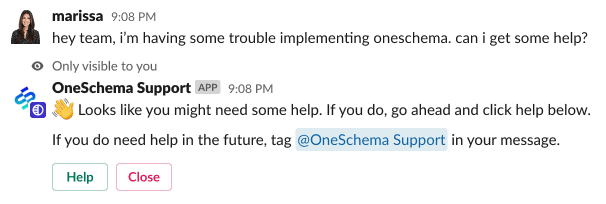
Turn on **Confirm if contacts are asking a support question** in **Settings > Ticket settings**. When a customer sends a new message that looks like a question, Pylon asks whether they want to open a ticket. You can customize the message on the same page.

This message is only visible to the question asker and balances ongoing education with minimal intrusion. If they click **Help**, Pylon opens a ticket. A customer is prompted at most once every 15 minutes.

<div align="center"><figure><img src="https://mintlify.s3-us-west-1.amazonaws.com/pylon/images/user-prompt.png" alt=""><figcaption></figcaption></figure></div>

## In-Thread Messages

These options are in **Settings > Ticket settings**:

* **Send ticket opened confirmation message**: post a confirmation in the thread that mentions who opened or closed the ticket.
* **Send ticket opened follow up message**: post a custom message after the ticket opens.
* **Allow users to close tickets within the thread**: add a **Close Ticket** button to the confirmation message. Requires the confirmation message.
* **Send ticket status update messages**: post a custom message when a ticket is closed or reopened.
* **Add checkmark reaction when ticket is closed**: add ✅ to the original message on close, and remove it on reopen.

## Closing and Reopening a Ticket

When **Allow users to close tickets within the thread** is on, the customer or your team can click **Close Ticket** in Slack. Your team can also close the ticket from Pylon. Teammates need permission to edit issues in Pylon to use the button.

Once a ticket is closed, the button changes to **Reopen Ticket**. Customers and teammates can click it to reopen the ticket, which moves it back to **On you**. A customer reply in the ticket's thread also reopens it. See [Replies after an issue is closed](/pylon-docs/integrations/chat/slack.md#replies-after-an-issue-is-closed).

<figure><img src="https://982123570-files.gitbook.io/~/files/v0/b/gitbook-x-prod.appspot.com/o/spaces%2F9hXBoCTTNw5flARlUVJf%2Fuploads%2FHjSaUhsw8be4xYcHGsUR%2Fimage.png?alt=media&amp;token=696671ce-e1c3-4a69-a1d6-4f4cf22423a7" alt=""><figcaption></figcaption></figure>

<figure><img src="https://982123570-files.gitbook.io/~/files/v0/b/gitbook-x-prod.appspot.com/o/spaces%2F9hXBoCTTNw5flARlUVJf%2Fuploads%2Fws71e0ZGvLmEzs6OpBWC%2Fimage.png?alt=media&amp;token=778e9e96-3dea-4250-b391-511041696d1c" alt=""><figcaption></figcaption></figure>


---

# Agent Instructions
This documentation is published with GitBook. GitBook is the documentation platform designed so that both humans and AI agents can read, navigate, and reason over technical content effectively. Learn more at gitbook.com.

## Querying This Documentation
If you need additional information that is not directly available in this page, you can query the documentation by asking a question.

Perform an HTTP GET request on the following URL with the `ask` and `goal` query parameters:

```
GET https://docs.usepylon.com/pylon-docs/integrations/chat/slack/support-ticket-flow.md?ask=<question>&goal=<user_goal>
```

`ask` is the immediate question: it should be specific, self-contained, and written in natural language.
`goal` is what the user is ultimately trying to achieve, the reason they need the answer. Sharing it helps GitBook give you a better, more relevant answer. A goal is most helpful when it describes the outcome the user wants rather than restating the question. For example, with `ask=how do I create an API token`, a goal like `automate deployments from our CI pipeline` lets GitBook tailor the answer to that use case.

The response will contain a direct answer to the question and relevant excerpts and sources from the documentation.

Use this mechanism when the answer is not explicitly present in the current page, you need clarification or additional context, or you want to retrieve related documentation sections.